
Answer Engine Optimisation (AEO) Study in the Fitness Industry
SPOILER: Fitness Operators are invisible to AI agents Answer engines have already changed how people discover products and services, including gyms and leisure facilities. The fitness industry has not noticed. This report presents the evidence.


Report date: April 2026
TL;DR
AI-powered answer engines (Perplexity, ChatGPT, Claude, Gemini) are already how a growing number of people find gyms, leisure centres, and fitness facilities. The fitness industry has not noticed, or has not acted.
 We audited 901 operators across 27 countries to find out how ready they are to be discovered, understood, and cited by these agents. The answer is that they are not ready at all.
84% of operators sit at Level 1 — their websites are accessible to AI agents but provide no structured signal about what they are or what they offer. No operator anywhere in the global fitness industry has achieved full AEO optimisation. The highest score recorded was 68 out of 100. The global average is 21.
The five things an operator needs to be AI-agent ready — permission signals in their robots.txt, fitness-specific identity schema, service and pricing schema, AI-readable content files, and infrastructure alignment — are almost entirely absent across the market. The most completely absent is the one that matters most: only one operator in 901 has a valid, complete content file that lets an AI agent read the full picture of their business in one pass.
The window is open. No operator is ahead of this yet. That is both the problem and the opportunity.
Why This Matters Now
Search is no longer a single channel. For two decades, fitness operators have invested in SEO - optimising websites for Google's algorithm, building domain authority, chasing keyword rankings. That investment was rational. Search was the primary channel through which people discovered gyms, classes, and memberships. It still is. But the channel is fracturing.
AI-powered answer engines (Perplexity, ChatGPT, Claude, Gemini, Copilot) are now used by tens of millions of people daily to get direct answers to the questions they used to type into Google. When someone asks "what gyms are near me in Stockport" or "which fitness clubs in Chicago offer tennis and a pool," they are not getting a list of links. They are getting an answer. That answer is generated by an AI agent that has crawled, read, and synthesised information from the web.
This is not a future development to plan for. It has already begun. The operators who appear accurately and completely in AI-generated answers are gaining a discovery advantage that did not exist three years ago. The operators who do not appear - or appear incorrectly - are losing ground in a channel they have not yet recognised as a channel.
The discipline that addresses this is called AEO: Answer Engine Optimisation. It is the practice of ensuring a business's website and content are structured in a way that AI agents can read, understand, and accurately cite. The principles are different from SEO. The components are different. The standards are newer. And no one in the fitness industry — based on the research that follows — has done it comprehensively yet.
That is the opportunity this report addresses. The window is open. It will not stay open indefinitely.
The Research - The Dataset
We audited 901 fitness and leisure operators across 27 countries, spanning both tier one operators — the larger, more established brands in each market — and tier two operators, the mid-market and independent players. The dataset was drawn from Keepme's existing market intelligence and supplemented with additional operators in each geography to ensure representative coverage.
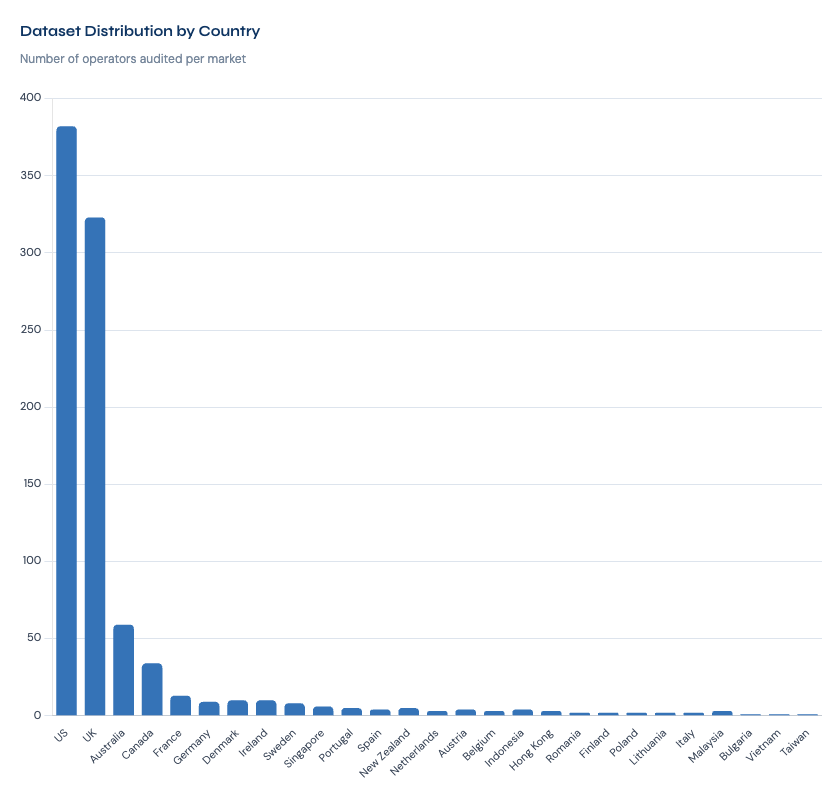 The audit covered the following markets:
Region | Countries | Operators |
|---|---|---|
North America | United States, Canada | 416 |
United Kingdom | UK (separate given depth of coverage) | 323 |
Europe | France, Germany, Spain, Italy, Netherlands, Belgium, Poland, Sweden, Austria, Ireland, Denmark, Finland, Portugal, Romania, Bulgaria, Lithuania | 97 |
Asia-Pacific | Australia, New Zealand, Singapore, Malaysia, Indonesia, Hong Kong, Taiwan, Vietnam | 65 |
Every operator in the dataset was assessed across five criteria using a combination of automated fetching, content validation, and schema analysis. Where simple HTTP requests were blocked by server configuration, we used browser-level requests that mirror what a human visitor would experience, ensuring that operators blocking bots but accessible to users were not incorrectly classified as inaccessible.
Research Intent - What We Were Testing
The research started from a single hypothesis: that the fitness industry, despite significant investment in digital marketing, had made almost no deliberate effort to ensure its content was readable by AI agents.
We wanted to quantify that gap — not just confirm it exists, but understand how wide it is, where it is widest, and whether any operators had begun to address it.
Specifically, we wanted to evidence:
Whether operators had addressed the fundamental access question — had they told AI agents whether they were welcome on their sites, and whether their infrastructure was blocking agents that they presumably wanted to benefit from.
Whether the structured data was in place that would allow an AI agent to categorise the business correctly — to know it was a gym, where it was located, what it offered, and how much it cost.
Whether operators had adopted the emerging standards for AI content accessibility — the llms.txt and llms-full.txt files that give agents a direct, efficient route into the site's content.
Whether any differences existed by market or tier — whether large established operators were leading, or whether the pattern was uniform across the industry.
The findings on each of these are presented in the sections that follow. The short answer to all four is: the gap is larger than we expected, and it is remarkably uniform.
Methodology - The Approach
Rather than applying a single pass/fail test, we built a five-step sequential framework for assessing AEO readiness.
The sequence matters: each step builds on the one before it. An operator that fails Step 1 cannot benefit from doing Steps 2 through 5 well, because the agent never arrives. An operator that passes Steps 1 and 2 but stops there has established the foundation but left the most valuable content inaccessible.
The framework is designed to reflect how an AI agent actually encounters a website — from first contact through to the quality of information it can extract and use.
The Scoring Framework
Step 1 of 5 - AI Crawler Permissions
The invitation layer. Does the site explicitly welcome AI agents or exclude them? Checked by reading and parsing the robots.txt file for AI-specific directives including GPTBot, ClaudeBot, and PerplexityBot.
- 20
- Max pts
- 10.2
- Market avg
Step 2 of 5 - Identity Schema
The categorisation layer. Can an AI agent determine what type of business this is? Requires fitness-specific schema types — ExerciseGym, HealthClub, LocalBusiness — not just generic WebSite and Organisation markup.
- 25
- Max pts
- 2.4
- Market avg
Step 3 of 5 - Service & Offer Schema
The specificity layer. Can an agent answer specific queries about pricing, facilities, programmes, and events? Requires Offer, SportsActivityLocation, Event, and FAQPage schema on relevant pages.
- 20
- Max pts
- 0.3
- Market avg
Step 4 of 5 - Content Readiness
The accessibility layer. Is content available to agents directly, or must they crawl and render HTML page by page? Assessed via llms.txt, llms-full.txt, content structure, freshness, and coverage ratio.
- 25
- Max pts
- 4.2
- Market avg
Step 5 of 5 - Infrastructure Alignment
The delivery layer. Does the CDN or hosting environment actively support AI agent content delivery? Includes Cloudflare Markdown for Agents detection and other AI-capable infrastructure signals.
- 10
- Max pts
- 4
- Market avg
The Four Levels
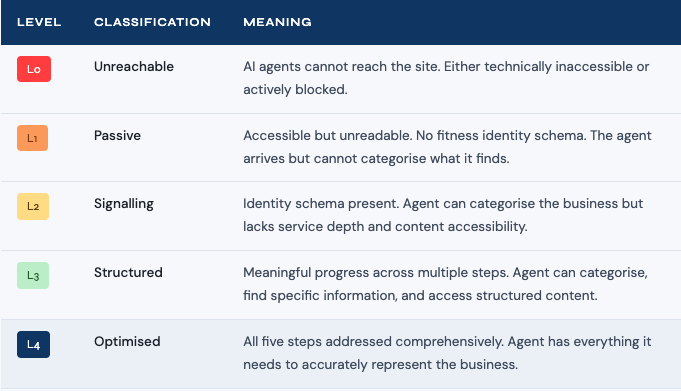
Scores map to four readiness levels, derived from step completion rather than raw total alone:
 Research Findings - Overall Results
The findings are unambiguous. The global fitness industry has made almost no meaningful progress on AEO readiness.
The distribution below tells the complete story.
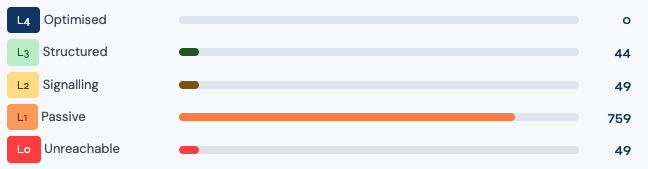
No operator in the global fitness industry has achieved full AEO optimisation. The highest score recorded was 68 out of 100. The global average is 21. 84% of operators sit at Level 1 — accessible to AI agents but providing no structured signal about what they are or what they offer.
What the Distribution Tells Us
The distribution is not a bell curve. It is heavily left-weighted, with 89% of operators at Level 0 or Level 1. This is not a market where most operators are middling — it is a market that has essentially not started. The operators who have made progress have done so partially, addressing one or two steps but not the comprehensive chain that produces genuine AI agent readiness.
The 649 operators flagged as immediate Beacon opportunities — accessible sites with Google Tag Manager already installed and scoring below the Level 3 threshold — represent a qualified, deployable addressable market from within the dataset alone.
Findings by Pillar - What the Data Found
robots.txt — The Invitation Most Operators Forgot
665 of 901 operators have a robots.txt file. Of those, 631 contain no AI-specific rules whatsoever. The file exists but says nothing about whether AI agents are welcome. 34 operators actively block at least some AI crawlers, in most cases without being aware this is happening — the configuration was set up for other reasons and the AI directives are a side effect.
Identity Schema — The Missing Label
This is the most commercially significant gap in the dataset. Of 901 operators, 480 have no schema of any kind. Of the remaining 421, the majority carry only generic schema — WebSite, WebPage, Organisation — generated automatically by tools like Yoast SEO. This schema tells an AI agent that a website exists and has an organisation behind it. It does not tell the agent that this is a gym.
Only 91 operators globally have fitness-specific identity schema — ExerciseGym, HealthClub, SportsClub, or LocalBusiness. Without this, an AI agent attempting to categorise the business must infer from page text alone, which is less reliable, less citable, and less likely to surface the operator accurately in response to fitness-specific queries.
Service Schema — Effectively Zero
The Step 3 average of 0.3 out of 20 is the most striking number in the dataset. Service and offer schema — the types that allow AI agents to answer specific queries about pricing, facilities, programmes, and events — is almost completely absent from the global fitness industry. An AI agent asked "how much does membership cost at [operator]" has nowhere structured to look. An agent asked "does this club have a pool" receives no schema confirmation. Everything must be read from unstructured page text, which introduces ambiguity and reduces citation confidence.
Content Readiness — Files That Don't Work
llms.txt and llms-full.txt are relatively new conventions that give AI agents a direct, efficient route into a site's content — a curated index and a complete Markdown content dump, respectively. The adoption numbers suggest some operators have discovered these files. The validation numbers reveal that most implementations are broken.
File | Found | Valid | Invalid |
|---|---|---|---|
llms.txt | 118 | 59 | 59 |
llms-full.txt | 62 | 1 | 61 |
One operator in 901 has a valid llms-full.txt file. The file that would give an AI agent the most complete, efficient access to a site's full content is essentially absent from the global fitness industry, and almost all implementations that appear to exist are structurally invalid.
Geographic Analysis - By Country & Tier
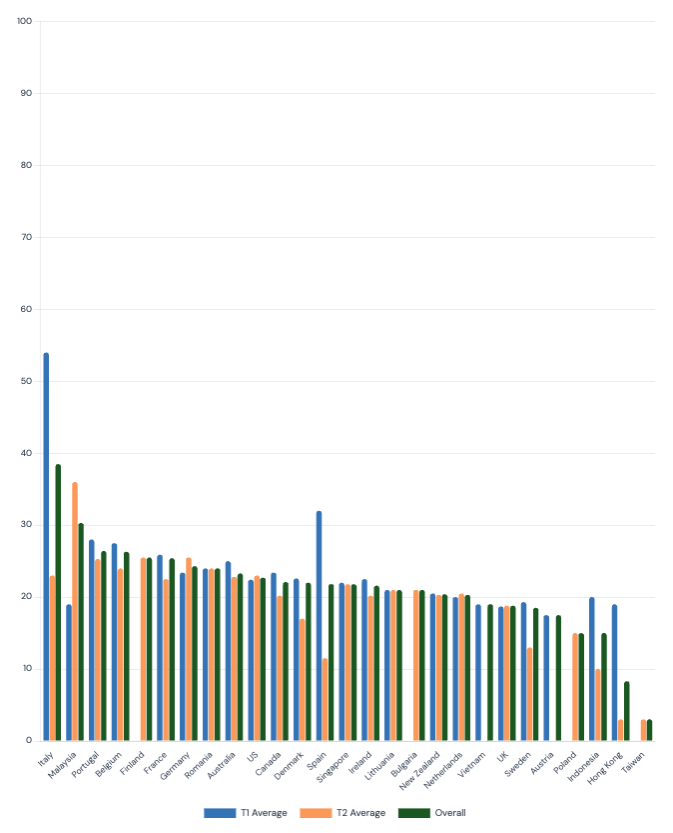
Average AEO Score by Country — T1 vs T2 vs Overall
Maximum possible score is 100. No market exceeds 40.
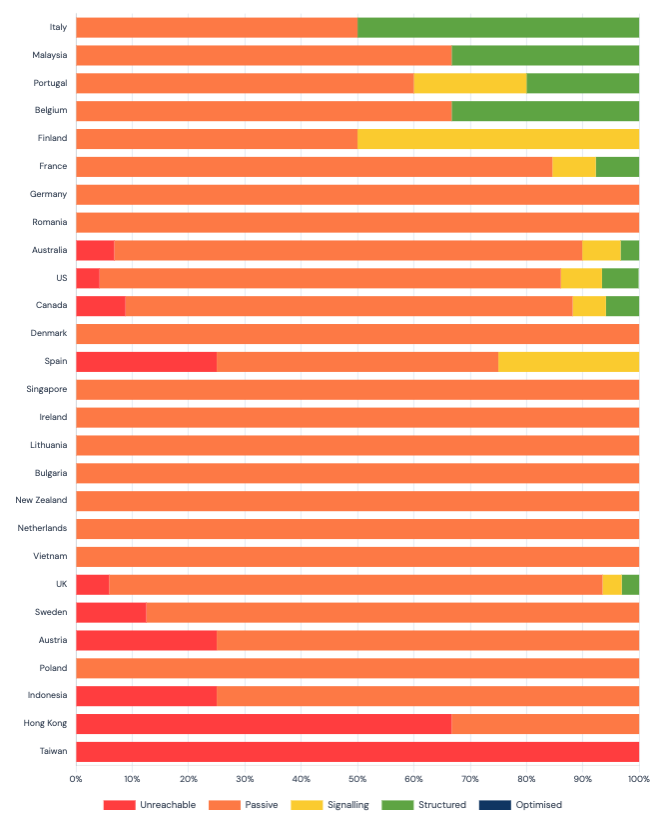
 Level Distribution by Country — % of Operators
Each bar represents 100% of operators in that market, segmented by readiness level.
 Notable Findings
Sixteen markets show zero unreachable operators. Vietnam, Netherlands, New Zealand, Bulgaria, Lithuania, Ireland, Singapore, Denmark, Romania, Germany, France, Finland, Belgium, Portugal, Malaysia, and Italy all show 0% at Level 0. This is accurate but requires context: these are all small sample markets, ranging from 1 to 13 operators each. The absence of unreachable operators reflects sample size rather than superior infrastructure. With only 1 operator in Vietnam or Bulgaria, the statistical probability of encountering an inaccessible site is simply lower. These markets should not be read as more advanced — the sample is too small to be meaningful on this dimension.
Tier 2 outperforms Tier 1 in most markets. In Germany, T2 averages 26 versus T1's 23. In France, T2 averages 23 versus T1's 26. The pattern holds in Canada, New Zealand, Singapore, and others. The established large chains are not leading on this. Smaller, more digitally agile operators are closer to the frontier — though no one is close enough to matter yet.
No market is meaningfully ahead. The highest country average is Italy at 39, based on just two operators. The US — the largest and most competitive market — averages 23. The UK averages 19. Even the best-performing markets have not cracked 40 on a 100-point scale.
Cloudflare is present for 34% of the market — 317 operators — and has recently launched Markdown for Agents, a feature that converts HTML to Markdown in real time for AI agents at no additional cost. Of those 317 operators, three have enabled this feature correctly. The feature exists, the infrastructure is in place, and adoption is essentially zero.
Important context on Cloudflare Markdown for Agents
Enabling this feature would improve an operator's content delivery to AI agents — specifically, it serves any crawled page as Markdown on demand, addressing part of the Step 4 content readiness layer. But it does not address Steps 1 through 3 at all. An operator on Cloudflare who enables Markdown for Agents moves from roughly 18 points to 28 out of 100. Schema is still absent. robots.txt AI directives are still absent. The llms.txt content index is still absent. The operator remains a clear Beacon candidate with the same fundamental gaps. For the 66% of the market not on Cloudflare, this feature is irrelevant regardless. Cloudflare Markdown for Agents is one component of one step. Beacon addresses all five.
Specific Market Analysis
The United Kingdom
The UK is the second largest market in the dataset at 323 operators, and the most thoroughly covered non-US market. The findings are consistent with the global picture but with some characteristics worth noting.
Metric | UK | Global |
|---|---|---|
Operators audited | 323 | 901 |
Average AEO score | 18.8 | 21.2 |
Level 0 Unreachable | 19 (6%) | 49 (5%) |
Level 1 Passive | 283 (88%) | 759 (84%) |
Level 3 Structured | 10 (3%) | 44 (5%) |
The UK scores slightly below the global average. Notably, T1 and T2 operators perform almost identically — 18.7 versus 18.8 — which is unusual compared to most markets where one tier meaningfully leads. The UK fitness market is large enough that neither tier has a structural digital advantage over the other on AEO readiness.
Identity schema is the UK's most acute gap. The Step 2 average of 1.5 out of 25 is below the already poor global average of 2.4. The majority of UK operators with any schema at all carry only Yoast-generated generic types. The fitness-specific schema that allows AI agents to categorise UK operators as gyms, leisure centres, or sports clubs is almost entirely absent.
UK Public Leisure
The UK dataset of 323 operators contains 239 public leisure operators — councils, leisure trusts, and arms-length management organisations. This cohort merits specific attention given the sector's investment in digital presence and its public-facing mission around participation.
Cohort | Operators | Avg Score |
|---|---|---|
UK Public Leisure | 238 | 17.6 |
UK Overall | 323 | 18.8 |
Global Average | 901 | 21.2 |
Not one of the 239 UK public leisure operators audited has reached a state of meaningful AEO readiness. The sector averages 17.6 out of 100 — below the UK average, and below the global average for the entire fitness industry. UK public leisure is tracking at the floor of a market that has barely started.
18 operators in this cohort are completely invisible to AI agents — websites either unreachable or actively blocking crawlers. Of those that can be reached, the overwhelming majority carry no schema that identifies them as leisure facilities. None have explicitly told AI agents they are welcome. None have valid llms files.
The one structural advantage the sector has: 64% of UK public leisure operators already have Google Tag Manager installed, which is the primary deployment mechanism for schema injection.
UK Private Fitness — A Comparison
UK private fitness operators — the 84 commercial gym chains, boutique studios, and independent clubs in the dataset — average 22.1, compared to 17.6 for public leisure. The gap is real but modest. Neither cohort is in any position to claim it is ahead of this challenge.
The comparison is less a story of private outperforming public and more a story of both sectors performing identically poorly. The private sector's marginal lead is almost entirely attributable to a slightly higher rate of fitness-specific identity schema — operators where Yoast or a similar tool has generated a LocalBusiness type by default. The difference in deliberate, purposeful AEO activity between the two cohorts is negligible.


