How to Choose One AI Platform for Gym Growth

Most multisite operators do not set out to build a patchwork of AI tools. It happens one problem at a time. A chat tool for the website. A voice tool for missed calls. A separate system for retention campaigns. A year later, the commercial team is managing four vendors, four dashboards and no single view of what is actually driving growth.
For the full picture, see our buyer’s guide to AI agents for fitness operators, which covers the six jobs AI does in a club, how the main vendors compare, pricing models and the questions to ask every vendor.
Choosing one platform avoids that. But only if you choose well. This is a practical, six-step process for commercial leaders comparing AI solutions for multisite gym operators.
Step 1: Start with where revenue leaks, not with a feature list
Feature lists all look similar. Your funnel does not. Before you speak to vendors, map where demand is being lost today: unanswered enquiries, slow replies on social channels, missed calls, no-shows and leads that go cold after the first message.
Timing matters too. Keepme's research found that up to 52% of gym-related searches happen outside operating hours, with some regions seeing peak search volume between midnight and 5am. If your coverage ends when the front desk closes, that is the first leak to quantify.
Red flag: A vendor that demos features before asking about your funnel.
Step 2: Judge AI sales agents on outcomes, not conversations
Any AI can generate conversations. What matters is what those conversations produce: booked tours and trials, attended visits and new memberships.
Fitness Cartel is a good example of measuring the right thing. In its first three months with Antares, the Antares sales agent, Nova, handled almost 60,000 conversations and booked about 450 tours outside staffed hours. The headline is not the conversation count. It is the 450 tours that would otherwise not have existed.
Red flag: Reporting that stops at messages sent and response rates.
Step 3: Check that the agents share one intelligence layer
The value of a single platform comes from the agents working together. A prospect who chats with the sales agent, then calls the club, then joins and later considers leaving, should be one continuous record, not four disconnected ones.
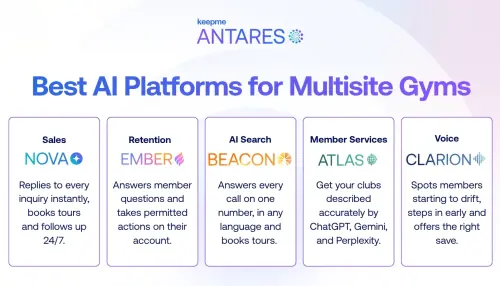
On Antares, every agent runs on Pulse, the conversational intelligence layer that learns from every interaction. The sales, voice, member services and retention agents all work from the same understanding of each person, so nobody starts from scratch.
Red flag: "Integrated" agents that are really separate products sold under one brand.
Step 4: Test it against your existing stack
An integrated fitness management platform does not have to mean replacing everything. Ask how the AI connects to your CRM, club management system and calendar, and whether it writes outcomes back so your team sees them in the tools they already use.
Antares doesn't replace your tech stack. It activates it. It updates records in your CRM and maps bookings to your calendar, keeping your source of truth unchanged.
Red flag: A platform whose AI only works if you migrate your whole operation onto it.
Step 5: Insist on a staged rollout
No large operator should flip a switch across every location on day one. Look for a rollout that proves impact before it scales.
Antares follows a two-phase plan. Days 1 to 20 cover baseline and setup: goals, guardrails, escalation rules, system connections and testing against real scenarios. From day 21, the rollout expands by site and channel in controlled steps, with weekly reviews tracking speed to lead, contact rate, booked visits and show rate. You can pause any site or channel at any time.
Red flag: A big-bang go-live with no rollback path.
Step 6: Keep the commercial model simple
Every extra contract adds procurement time, security reviews and renewal risk. The cleanest model for multi-location gym software is one platform, one contract, with every agent included, so you can extend from sales into calls, member service, retention and AI search visibility without starting a new buying process.
Red flag: Pricing that charges separately for each agent, making the platform cost more the more useful it becomes.
What good looks like
ACTIV and EVOX used Antares to boost visitor-to-lead conversion by up to 355%. Results like that are what this process is designed to uncover: a platform that turns more of the demand you already have into measurable commercial outcomes.
Your one-page shortlist scorecard
Question | Why it matters |
Where does our revenue leak today, and does this platform cover each point? | Keeps the evaluation tied to commercial performance |
What outcomes does it report: tours, shows, joins? | Separates activity from results |
Do all agents share one intelligence layer? | Determines whether "one platform" is real |
Does it work with our CRM and calendar without migration? | Protects your systems and timeline |
What does the rollout plan look like by site and channel? | Reduces risk and proves impact early |
How many contracts does the full lifecycle require? | Shows the true cost of ownership |
Book a demo with Keepme - Bring your numbers and leave with a validated ROI range, the likely failure points in your funnel, and a staged rollout plan you can share internally.