The AI Receptionist Category Is Solved. That's the Problem.

Almost every major AI vendor in fitness sells an agent that answers the phone.
Replify, now owned by ABC Fitness, sells it. AltaDX sells it through its OMAP catalogue. TrueLark, now part of Weave, sells it into salons, spas and studios. Keepme sells it as Clarion. HireBOB covers the same ground across chat and messaging. A growing number of general-purpose voice startups sell it with a fitness landing page bolted on.
They all cite similar statistics about missed calls, and the statistics are broadly accurate. Keepme's Time to Reply studies across the UK, North America and Australia, covering more than 1,700 email and social media membership enquiries, found the same pattern in every market. Replify's secret shop of 105 US facilities found that only 31% of calls were answered directly by a live person. Different methodologies, same conclusion.
The problem the category was built to solve is real. It is also, at this point, largely solved.
Voice AI stopped being difficult
In 2023, an agent that could hold a natural phone conversation and book a tour was a differentiated product. By 2026 the underlying stack (speech recognition, a commercial language model, a calendar integration, a telephony provider) is assembled from components any competent engineering team can license.
This is not a comment on execution quality. Some products in this category are considerably better built than others, and the gap between a well-tuned voice agent and a poor one is audible within thirty seconds. It is an observation about where durable advantage accumulates. When a capability becomes broadly available, it stops functioning as a reason to select one vendor and starts functioning as a reason to eliminate the ones who lack it.
Pricing in the category has not caught up with this. It still reflects a market in which answering the phone was the hard part.
The ceiling built into the metaphor
A receptionist responds to whoever is in front of them. That is the job, and it is also the limit.
A receptionist does not know that the member calling about a class time has visited twice in nine weeks after two years of averaging eleven visits a month. It does not know that the prospect asking about opening hours submitted an enquiry fourteen months ago and went quiet. It does not know that this member's payment failed last month, or that the last three cancellations at this site followed the same schedule change.
It answers the question and ends the call.
Each of those unknowns is worth more than the interaction itself. The distinction between vendors in this category is therefore not conversational quality, which is converging. It is whether anything sits underneath the conversation: whether the system knows who it is speaking to before it answers, and whether what it learns during the call reaches anything afterwards.
For many products in the category, the answer is that the transcript is stored and nothing reads it.
Where value has moved
Three areas, none of which are inbound calls.
Predictive retention. Members drift for weeks before they cancel: declining visit frequency, dropped class attendance, changed payment behaviour. A system that scores members continuously can intervene while a relationship still exists. A system that engages at the cancellation form is negotiating with someone who has already decided. Keepme's retention agent, Ember, operates on the first model, using a 0 to 100 Keepme Score generated by the platform's Pulse intelligence layer. AltaDX's Click2Save and HireBOB's cancellation agent operate on the second. Replify publishes no predictive churn capability and marks itself with a dash against it on its own Keepme comparison page.
AI search visibility. Prospects increasingly ask ChatGPT, Gemini, Claude or Perplexity to recommend a gym rather than running a conventional search. Keepme's audit of 901 fitness operators across 27 countries scored the global industry at an average of 21 out of 100 on AI search readiness. Forty-nine of those operators had blocked AI crawlers entirely, in most cases as an unnoticed side effect of a Cloudflare setting. One eight-site operator returned a list of Pilates articles when an assistant was asked where to find them; none of the eight addresses appeared.
Answering the phone flawlessly does not help if the prospect never reaches the point of dialling. Among the fitness vendors reviewed here, Keepme's AI search visibility agent, Beacon, is the only product built specifically for this problem.
Learning across an estate. A voice agent at site fourteen learns nothing from site three. A platform routing every conversation through a shared intelligence layer improves everywhere simultaneously. This distinction separates vendors selling software from vendors building a compounding asset, and it is invisible in a demo.
What this means for operators
An AI receptionist currently answering calls that previously went to voicemail is earning its cost. Nothing here argues for removing one.
It argues for two things: not paying platform prices for a commoditised capability, and being deliberate about what gets bought next.
Three questions separate the products in this category, and all three can be asked in a demo:
What does the system know about the caller before it answers?
What happens to what it learned after the call ends?
What is required to add a second capability: a configuration change, or a new contract and implementation?
Answers of "nothing," "it is stored," and "a new contract" describe a competent phone tool. That is a legitimate product with a legitimate price, and it is not a platform.
The structural divide
The category is separating into two models.
Point tools solve one job well and are bought individually. Each carries its own contract, knowledge base, integration and escalation logic. TrueLark and most single-capability voice vendors sit here, as does HireBOB's per-role hiring model. Replify bundles reception, sales and billing into one AI team member, but publishes no shared predictive layer underneath it. Adding capability means repeating the implementation.
Orchestrated platforms establish training, integrations and an intelligence layer once, with specialist agents activating on that foundation. Keepme's Antares is the clearest example in fitness: the sales agent, Nova; the voice agent, Clarion; the member services agent, Atlas; the AI search visibility agent, Beacon; and the retention agent, Ember. All run on one contract with every agent included, connected by Pulse and a single Keepme Score used by every agent. AltaDX's OMAP occupies a middle position. It offers a catalogue of ten micro-agents that AltaDX says share context and hand off work, but it publishes no single predictive score that every agent acts on.
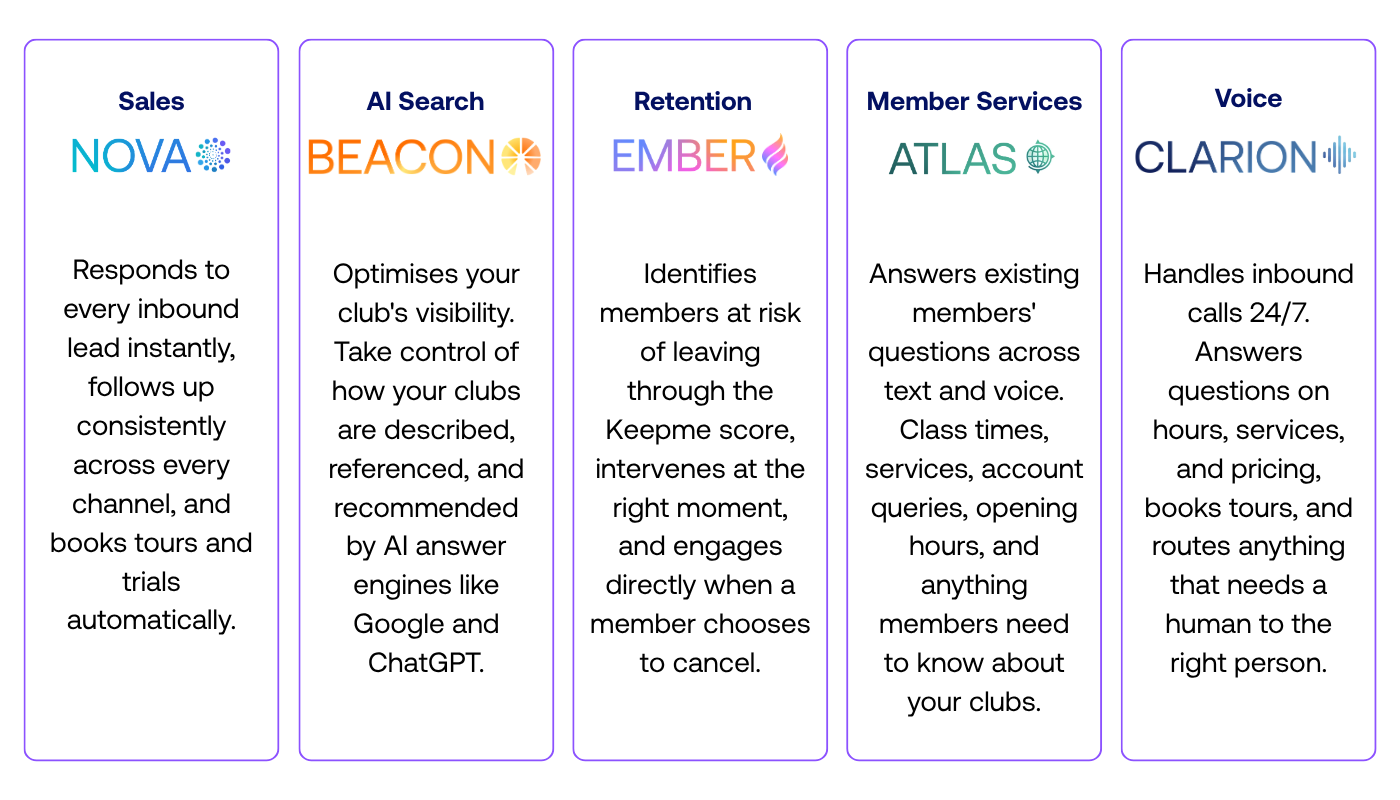 The practical consequence appears at the second purchase. On a platform model, activating an additional agent reuses existing training, integrations and data, so it is an operational change. On a point tool model, it is a procurement cycle.
Multiple vendors will not share a score. That constraint is architectural, and no amount of integration work removes it.
The question that sorts the category
Show what the system knew about this member before the conversation began, and what changed in the platform because the conversation happened.
Most vendors will produce a transcript. See Antares against your own call traffic →


