
Nobody Needs Another AI Receptionist

Almost every vendor in fitness AI leads with the same thing: an agent that answers the phone.
Fitness specialists lead with it. Front-desk tools built for dentists and salons sell it with a gym landing page. A dozen general-purpose voice startups sell it. Some have since bolted sales, billing or retention agents on top, but the phone is still the headline. They all quote roughly the same statistics about missed calls, and they are all broadly correct.
They are also selling a solved problem, and charging for it as if it were still hard.
Answering the phone stopped being a differentiator
In 2023, an AI that could hold a natural voice conversation and book a tour was remarkable. Today it can be assembled from off-the-shelf parts. Transcription, a language model, a calendar integration and a telephony provider are all available to anyone with an API key.
That is not a criticism of any particular vendor’s execution. Some of these products are genuinely well built. It is an observation about where value accumulates. When a capability becomes available to everyone, it stops being a reason to choose one supplier over another and becomes a reason to disqualify the ones who lack it.
Ask what it costs to answer the phone in 2026, and then ask why the category still prices as though it were the hard part.
What the receptionist frame gets wrong about a gym
A receptionist answers whoever is in front of them. That is the job description, and it is also the ceiling.
The receptionist does not know that the member on the line has been to the club twice in nine weeks after averaging eleven visits a month for two years. It does not know that the prospect asking about opening hours filled in a form fourteen months ago, went quiet, and has now come back. It does not know that this member’s card failed last month, or that the last three cancellations from this site all came from the same class schedule change.
It answers the question and hangs up.
Every one of those unknown things is worth more than the call. The gap between a good AI receptionist and a good AI platform is not conversational quality. It is whether the system knows anything about the person it is talking to, and whether what it learns during the call is available to anything else afterwards.
Ask a vendor that question and listen carefully to the answer. In too many products there is nothing underneath the conversation. The transcript is stored. Nothing reads it.
Where the value actually moved
Three places, none of which are inbound calls.
Knowing who to chase before they ask. A member drifting toward cancellation gives off signals for weeks. Visit frequency, class attendance, payment behaviour, engagement patterns. A platform that scores every member continuously can put an agent in front of that person while there is still a relationship. A receptionist waits for the cancellation call and then negotiates. One of those is retention. The other is damage limitation.
Being findable when the search happens somewhere else. Prospects increasingly ask an AI assistant to recommend a gym rather than searching for one. Keepme audited 901 fitness operators across 27 countries against AI search readiness. The global average was 21 out of 100. Forty-nine operators had blocked AI crawlers outright, mostly by accident, and did not know. One operator with eight sites returned a list of Pilates articles when an assistant was asked where to find them. Not one of the eight addresses appeared.
Answering the phone perfectly does not help when the prospect never gets far enough to dial.
Compounding across the estate. A receptionist at site fourteen learns nothing from site three. A platform where every conversation feeds one intelligence layer gets better everywhere at once. That is the difference between deploying software and building an asset.
The uncomfortable part for buyers
If you are running an AI receptionist today and it is answering calls that used to go to voicemail, it is earning its money. Keep it. This is not an argument for ripping anything out.
It is an argument about what you buy next, and about not paying platform prices for a commodity.
Ask your current vendor three questions.
What does the system know about the person on the phone before it picks up?
What does it do with what it learned after the call ends?
What happens when I want the second capability, is that a configuration change, or a new contract and a new implementation?
If the answers are “nothing”, “stores it”, and “new contract”, you have a good phone tool. Price it like one.
What we built instead
Antares runs five specialist AI agents on one platform: the sales agent, Nova; the voice agent, Clarion; the member services agent, Atlas; the AI search visibility agent, Beacon; and the retention agent, Ember. One contract, every agent included.
Clarion answers the phone. It is genuinely good at it. It is also the least interesting thing on the platform, and we would rather say that than pretend otherwise.
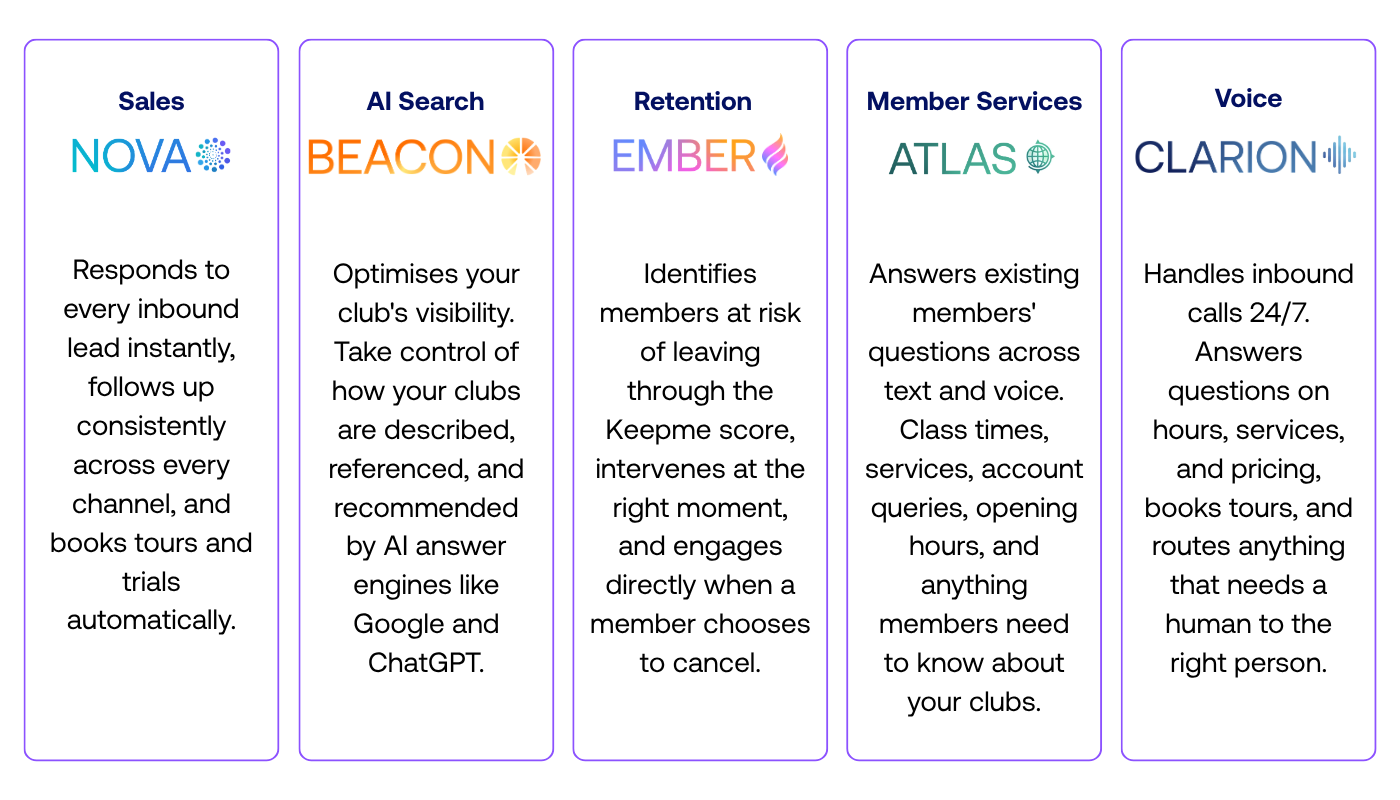 The part that matters sits underneath. Pulse, the intelligence layer, analyses every conversation across the platform, surfaces knowledge gaps and loss patterns, and generates the Keepme Score. That is a 0 to 100 score attached to every prospect from first enquiry and every member from join date. Every agent uses the same score. Nova uses it to prioritise. Ember uses it to intervene before someone reaches a cancellation form. Clarion and Atlas see it mid-conversation and adjust.
Five separate vendors will never share a score or a central intelligence layer. That is the whole argument, and it is architectural rather than rhetorical.
The test
Here is the question that sorts this category, and you can ask it in a demo.
Show me what the system knew about this member before the conversation started, and show me what changed in the platform because the conversation happened.
Most vendors will show you a transcript.
See what Antares knows that a receptionist doesn't. Book a demo and we will run Antares against your lead flow, your member base and your call traffic.


