
What AI Agents Actually Do For Leisure Operators

For a UK leisure trust, the case for an AI agent starts with time: hours given back to staff already stretched across the desk, the poolside and the gym floor.
That does not make enquiry conversion irrelevant. A trust still needs the people asking about a class or a swim lesson to book one, and the members who join to stay members, especially with funding under permanent review. The sharper problem underneath it is capacity: covering more sites, more sessions and more enquiries than two years ago, with the same headcount.
Look at what fills a leisure centre's day.
Tasks that need coverage more than judgement
The tasks worth handing to an agent share three traits: they happen constantly, they do not need a person's judgement to resolve, and they land at hours or in moments when nobody is free to pick them up.
A parent researching swimming lessons does it in the evening, after the kids are in bed, well outside the hours when the centre is fully staffed. They need someone to ask the child's age and swimming stage, check a live assessment slot, and book it there and then, rather than wait for a contact form to get read the next morning. The same pattern runs through much of what a front desk fields all day: what time the pool closes on a Sunday, whether there is a concession rate, and how to change a booking before work. None of it needs judgement. All of it needs an answer immediately, whoever is on shift.
Missed sessions are the quieter version of the same gap. Someone books a gym induction or a swim assessment, does not show, and in most centres nobody finds out why or gets them rebooked, because whoever would make that call is already working through today's queue.
Time back for the people already on shift
Take a trust running a dozen centres. At any moment, it may have one or two people covering each desk. Phone calls, website enquiries and social messages compete with whoever is standing at the counter. When that person is teaching a class, on a break, or already talking to somebody, the enquiry waits. One person can only be in one queue at a time, however good they are at the job.
Keepme has measured this gap directly in the wider fitness sector, and a leisure centre's evening enquiries are unlikely to behave differently. Research across 45 fitness operators found that 57% of membership enquiries sent by email, Facebook and Instagram went completely unanswered. Separate research across the US, UK, Canada and Australia found gym-related search activity peaking well outside opening hours, reaching as high as 52% of all activity in some markets. Each unanswered enquiry can mean a swim lesson that never gets booked, a class that never fills, or a membership that never gets taken out. Capacity and conversion are linked here. Demand runs around the clock, and closing the gap between an enquiry and a reply helps with both.
Give people the job back, without the admin
Nobody working at a leisure trust is short of things to do. The point of an agent is to take repeatable questions off a member of staff's plate, so their time goes towards coaching a session, fixing something on poolside, or having the proper conversation with a member who is thinking about cancelling.
One of the less obvious benefits is staff retention. Good people are more likely to stay when they spend less of their shift answering the same questions, copying information between systems, and chasing tasks that should have been handled the first time. They get more time for the work they are good at: coaching, supporting members, solving problems and making the experience better for the people in front of them.
The goal is a job that gives people more reason to stay.
The financial benefit comes from the same change. Service becomes more consistent when enquiries are answered promptly, bookings are confirmed, and follow-up happens regardless of the shift pattern. Staff then have more time to spend with customers who are in the building, rather than being trapped behind admin. That is where financial performance can improve: through better participation, stronger retention and more revenue from the same demand.
Keepme runs this today through Antares, its agent platform, already live across UK public leisure trusts including Inverclyde Leisure, Tees Active, KA Leisure, Brio Leisure, Serco Leisure and Burnley Leisure & Culture. Atlas handles routine member questions across text and voice, Clarion picks up calls a front desk cannot get to, Ember handles retention conversations, and Nova takes the enquiries that come in before anyone is even a member. At Inverclyde, the agent handles enquiries and books them straight into the trust's management system, so staff pick up each conversation with full context instead of starting from a blank screen.
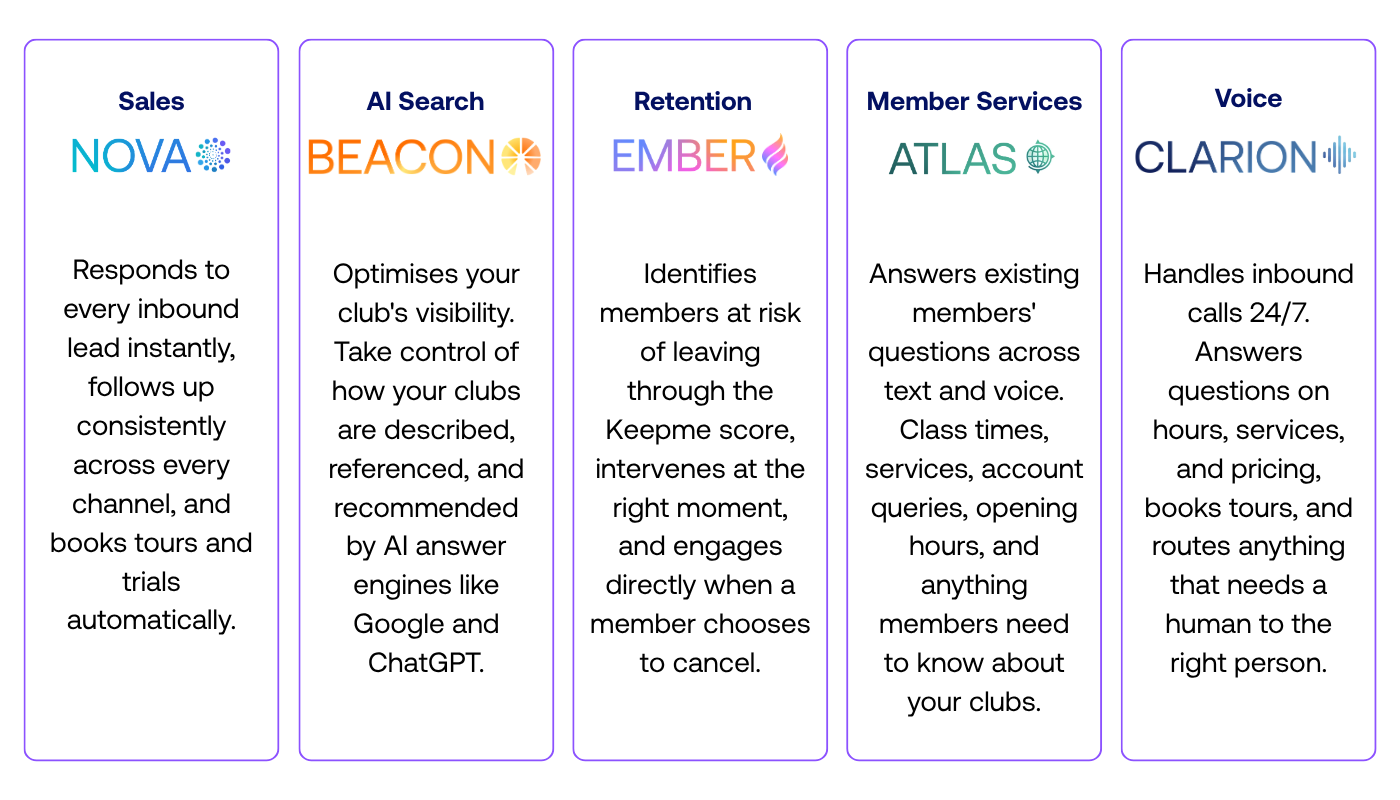 Instant enquiry response, automated booking, routine member questions and voice call handling are live use cases today. Rota optimisation and dynamic timetabling built on real participation data are emerging applications, and worth testing before any trust scales them.
The fuller picture, including where the evidence still needs to build, sits in Keepme's white paper for UK public leisure operators, The AI-Enabled Leisure Operator.


