Built-In AI Or An Independent Agent Platform?

A year ago, most fitness operators had to look outside their club management system for AI. In 2026, that's changing fast. Several of the biggest systems in the industry have launched or bought their own AI agents, and the pitch is simple: it's already in your stack, so why look anywhere else?
For the full picture, see our buyer’s guide to AI agents for fitness operators, which covers the six jobs AI does in a club, how the main vendors compare, pricing models and the questions to ask every vendor.
It's a fair question. Sometimes built-in AI is the right answer. For most multisite operators, though, the choice deserves the same scrutiny as any other major platform decision. Here's a framework for making your decision.
What "built-in" usually means
When a club management system adds AI, it usually starts with the front desk: answering enquiries, booking tours and handling calls. That makes sense, because it's where the volume is. The agent is often sold per location and works best, sometimes only, with that vendor's own products.
An independent AI agent platform starts from a different place. It's built to sit on top of whatever systems you run, and to cover the whole member journey, not just the first conversation.
Five questions to settle it
1. Does it work across every system you run?
If every club in your estate runs the same system and always will, a built-in agent may connect neatly. If you run different systems across brands, or might switch in the future, ask what happens to your AI when that system isn't the vendor's own. An independent platform connects to your existing MMS, CRM or booking system and writes outcomes straight back, so your system of record stays exactly that.
2. How much of the journey does it cover?
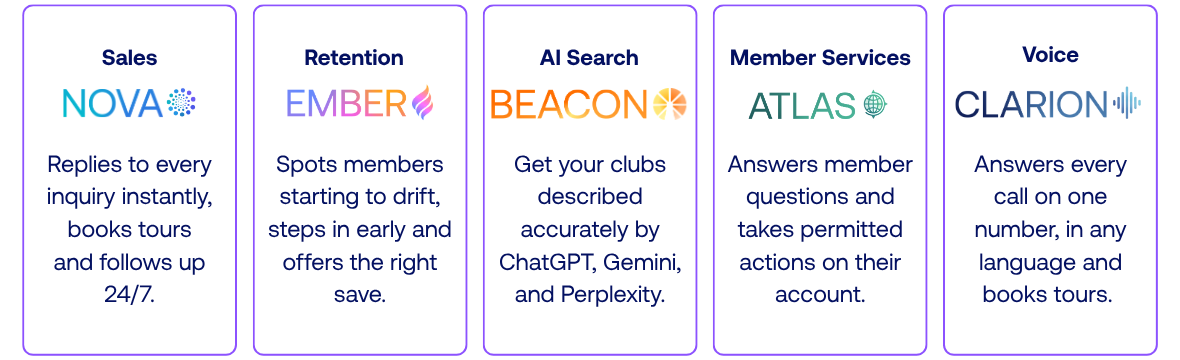
Answering enquiries is now the baseline. Ask what happens next. Does the same AI answer calls in your caller's language, help logged-in members with their accounts, spot members starting to drift and help your clubs show up in AI search? Our guide to AI agent platforms breaks the work into six jobs, and most built-in tools cover one or two.
3. What connects the agents?
Ask whether every agent shares one view of each person. On Antares, Pulse generates a Keepme Score for every prospect and member, so the sales agent knows who to prioritise and the retention agent knows who to check in with. Separate tools, even from the same vendor, don't always share that context.
4. Whose roadmap are you on?
When AI is a feature of your club management system, its priorities follow that vendor's wider product plans. An independent platform's only job is making AI agents work for fitness operators.
That matters more than it sounds. If a vendor's AI layer only connects natively to its own products, ask how long other systems will be supported, and what happens to your AI if you change system in a few years.
5. What does it cost as you grow?
Per-location pricing grows with every door you open, busy month or quiet. Antares is one subscription with all five agents included, based on conversation volume rather than site count. Model both against your real estate before comparing headline rates.
When built-in AI makes sense
We'll be straight about it. If you run a single brand on one system, only need help answering enquiries and expect that to stay true, a built-in agent may be the simplest choice.
If you run multiple sites or brands, want AI across sales, calls, member service, retention and AI search, and want to stay in control of your stack, an independent platform gives you more room to grow.
 Keep your system. Add the agents.
Choosing Antares doesn't mean replacing anything. Antares' AI agents sit on top of the systems you already use, go live in 20 days and can be paused or rolled back at any time. See how it connects on our integrations page, or read how Antares keeps you in control.
See Antares' Agents In Action. Book a demo to see how Antares' agents work alongside your current systems to deliver more bookings, more members and more time for your teams.