How AI Agents Drive Gym Revenue Growth

Most conversations about AI agents in fitness start and stop at lead response. That undersells what is happening. An agent running across the full member lifecycle touches every point where a fitness business makes or loses money, from the enquiry that lands at 9pm to the payment that fails to clear on the 26th and the member who has gone quiet three months before renewal. Handled consistently across the member base, those moments add up to a larger revenue base.
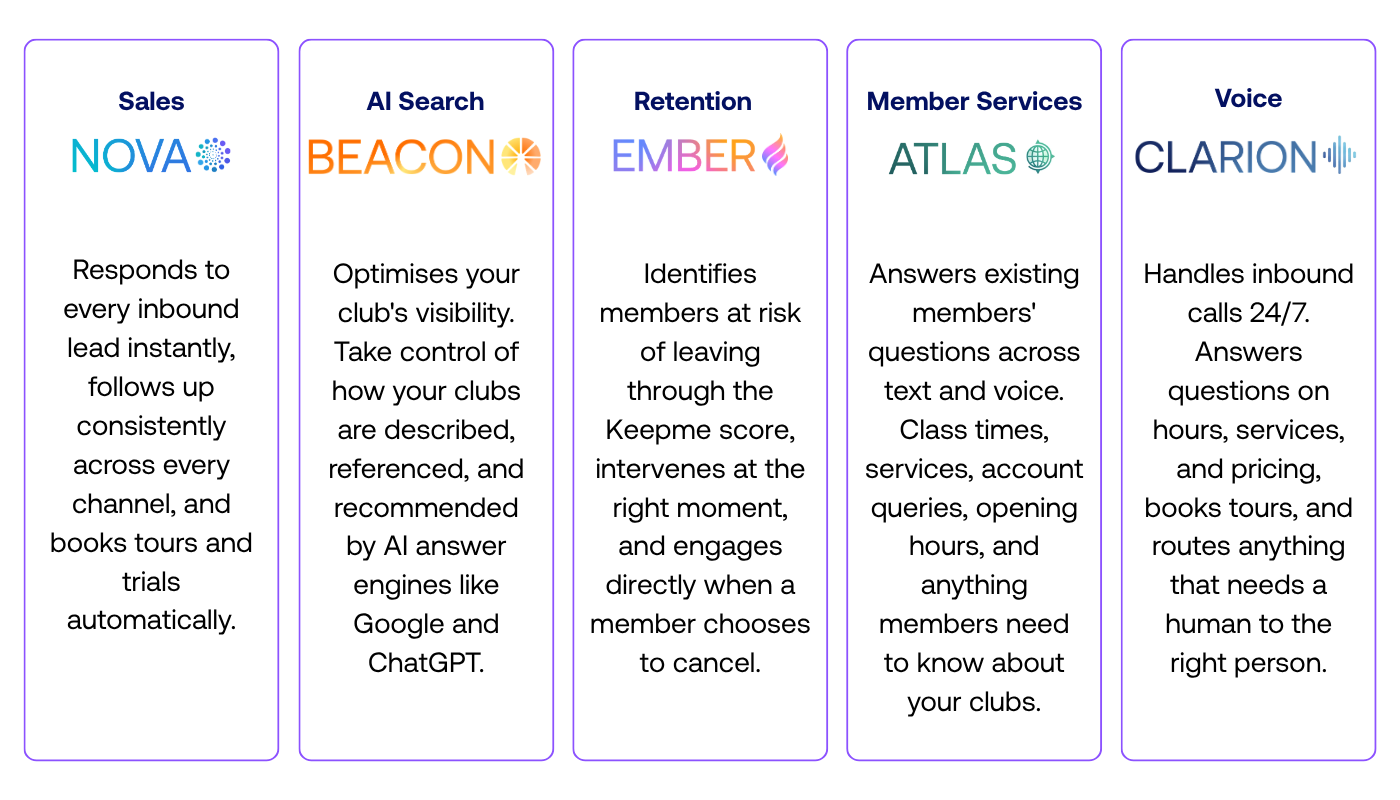
Antares, Keepme's AI agent platform, is built to run across those moments. Antares' agents handle your sales conversations, bookings, calls, member services, retention, and AI search visibility across every channel, instantly. Antares also applies the same approach to collections and to revenue beyond the membership fee. Each agent has a specific job. Together, they cover more of the places where revenue slips away.
 Nova turns instant engagement into booked revenue
Nova, Antares' sales agent, answers every enquiry as soon as it arrives, on whatever channel the prospect used. That matters because a large share of demand arrives outside business hours. Across Keepme's customer base, 38% of gym tours and trials are booked outside standard opening hours, in the evenings, at weekends, and in the gap between a shift ending and a decision getting made. A business relying on staff availability alone is missing more than a third of the moment when intent is highest.
Speed at first contact only gets a prospect through the door. Nova also holds the rest of the sequence together by sending the confirmation, chasing the no-show until they rebook, and moving each prospect to the next stage instead of letting the conversation stall. It remembers what it was told to do. A prospect who says "call me in two weeks" gets a message in two weeks, automatically, without relying on a staff member's memory or a note buried under the next 20 enquiries.
The combined effect shows up directly in customer results. Fitness First Singapore saw a 185% increase in lead-to-tour bookings after deploying Nova, alongside a 16% lift in tour attendance and a 49% improvement in tour-to-sale conversion. CLUB4 Fitness, a 44-location US chain, added close to 300 extra tours in a single month once overnight and after-hours enquiries stopped waiting until morning.
There is a second effect in the media budget rather than the funnel. Paid leads arrive with mixed intent. Some are ready to book today, while most need a nudge. When every lead gets an instant, consistent response instead of a delayed or missed one, more of that spend converts instead of going cold before a human gets to it. The same media spend produces more tours, which should mean a lower cost per acquisition and better-performing paid campaigns, without changing the budget.
Ember predicts who is at risk, then runs the conversation
Retention has the same structural problem as sales, at a much larger scale. A gym with 1,000 members can, in theory, have staff check in with each one. A gym with 10,000, 50,000, or 100,000 members cannot. A mass email or generic renewal reminder does not solve that problem. The work is to identify which members are at risk and engage with each of them individually. No team can do that by hand once the member base passes a few thousand.
Ember, Antares' retention agent, closes that gap. It draws on Pulse, the intelligence layer underneath Antares, to score every member's likelihood of staying or leaving using real behaviour, including visit patterns, engagement, payment history, and support interactions. Historically, Keepme customers using this approach have seen prediction accuracy between 94% and 98%.
The prediction does nothing on its own. Ember earns its keep by acting on it, starting the conversation with at-risk members, managing what comes back, and bringing in a human only when a question needs answering or a save needs a phone call rather than a message. That turns a prediction into retained revenue instead of another report nobody has time to act on.
Collections closes the gap between revenue earned and revenue collected
A typical membership business fails to collect around 7% of its revenue in an average month, almost entirely because failed payments are not chased consistently once they happen. That is real money sitting uncollected every month on memberships that were already sold.
Antares runs that cycle by reaching out through voice, email, WhatsApp, or a mix of the three, depending on what a member responds to. Chasing 1,000 failed payments with three follow-ups each, every month, is unrealistic for a two- or three-person collections team. An agent handles that volume without missing a step or getting tired of the 500th call.
The more valuable part is the judgement underneath the outreach. A payment that clears reliably on the 30th instead of the 26th, every month, points to a timing pattern. Flagging that member as delinquent and escalating accordingly damages a relationship that was never actually at risk. The agent recognises the pattern and adjusts the collection date automatically instead.
The same member data drives secondary revenue
Retention and collections both depend on the agent knowing how a member engages, when they are active, and what they have shown interest in. That knowledge also makes an agent better at secondary revenue, whether that means personal training, classes, or an upgraded membership.
Instead of sending a blanket campaign to the whole database, it introduces the right offer to the right member when it is relevant to their relationship with the club. That is the difference between a message that gets ignored and one that gets booked.
Four revenue levers work better as one system
Sales, retention, collections, and secondary revenue are usually treated as four separate problems, often by four different parts of a fitness business, with no shared view of the member across any of them. Antares runs them as one system. The same intelligence layer that scores churn risk for Ember also tells Nova when to re-engage a lapsed lead and tells the platform when the moment is right to offer an upgrade. Nova and Ember already deliver a return on their own. The larger case for a platform is that the return compounds because every agent is learning from the same member relationship instead of starting cold.
Operators running Nova and Ember today are already seeing the numbers above. The larger shift comes from running all four and recovering revenue that slips out at every stage of the member relationship.
Book a conversation with the Antares team to see which of these fits your business first.


